Describe the operating model
Define the systems, relationships and rules that matter for a domain. Agents work against that explicit model instead of reconstructing one for every prompt.

Give AI agents and automation a bounded model of live IT and OT state. Kubling federates that state directly from its sources, so there is no central copy to build first.
Can workloads leave rack 07 without violating redundancy?
Move one dependency first. The proposed sequence checks live capacity and the current maintenance window.
An agent can call every system and still have to reconstruct the operation for each prompt.
A typical tool or MCP integration still leaves the agent to infer the model. Kubling makes the shared entities, relationships, source ownership and valid actions explicit.
Define the systems, relationships and rules that matter for a domain. Agents work against that explicit model instead of reconstructing one for every prompt.
Queries and mutations cross databases, APIs and infrastructure. Each provider translates them into the source's native protocol and executes them near the system.
Providers retain their credentials, source logic and release cycle. Kubling handles federation, planning and policy across them.
Kubling's OpenAPI provider exposes API operations as relational entities. Query them alongside databases, Kubernetes and physical infrastructure. Mutations map back to the API's own HTTP operations, so the API remains authoritative.
Explore the OpenAPI provider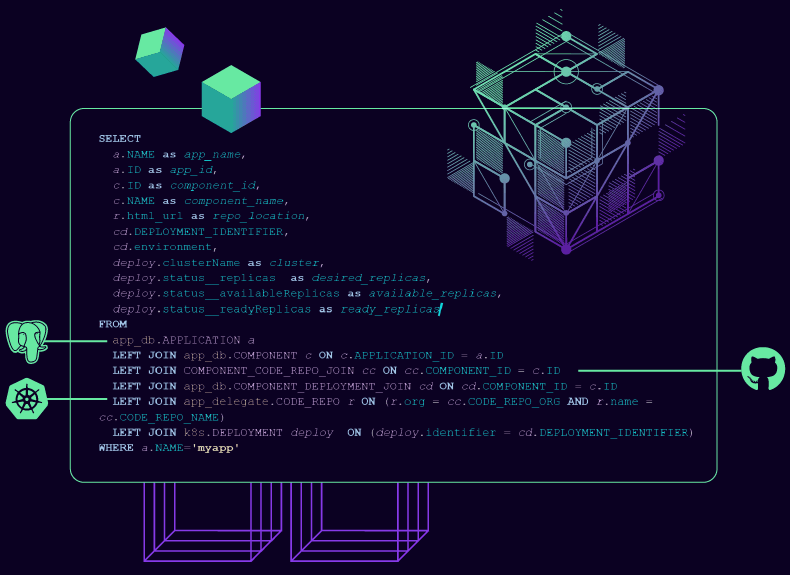
Deploy Kubling around the teams, sites and systems that already own the operation. An instance can use local providers, federate other Kubling instances, or do both. Connect them when a broader view is needed.
Platform-less does not mean architecture-less.
There is no required central instance or big-bang platform program. Start with one operational domain and connect others as the scope grows.
A provider is an independent service behind Kubling's public gRPC contract. It can use the source-native client and release independently from the engine. The provider language and deployment model are up to the team.
The provider protocol, Go SDK and official providers are open source; the engine is not. Teams can inspect the boundary and build their own providers against the same contract.
Explore provider sourceProviders run outside the engine.
Plans queries and cross-source execution.
Maps Kubling operations to the source client.
Relate facilities, hardware, workload placement and maintenance before a local warning becomes a service incident.
Explore data centersResolve Kubernetes state, APIs, application inventory and ownership through one federated model.
Explore IT operationsKeep device access close to the process, add asset and maintenance context, then federate upward when needed.
Explore industrial operationsArchitecture decisions, implementation notes and the ideas behind federated operations.
Run a query and a mutation against a small local stack. Replace the in-memory source with Kubernetes, OpenAPI or your own provider later. Kubling still plans through the same contract.


