01
Kubernetes clusters
Resources, status, placement and supported changes
One official provider instance per cluster

Platform teams already have the data. The hard part is resolving a service, its owner, its deployments and its current incidents across systems that were never designed to answer together.
Which failing deployments affect customer-facing services, and who owns the next action?
Join live Kubernetes resources to application inventory, ownership and incident data. The result stays traceable to each source, and supported changes go back through the provider that owns them.
Cluster state is only one part of the answer. Ownership, repositories and incidents stay authoritative in their own systems.
Resources, status, placement and supported changes
Repositories, incidents, deployments and business state
Applications, customers, ownership and policy
Models already owned by another team or site
The model carries identity across source boundaries. A service can resolve to its deployment, cluster, repository, incident and owner without an agent guessing how those names relate.
Resolve a business-facing service to the workloads, repositories and teams behind it.
Query the clusters and APIs in place instead of reasoning over another delayed copy.
The planner pushes down only the operations each provider says it can preserve.
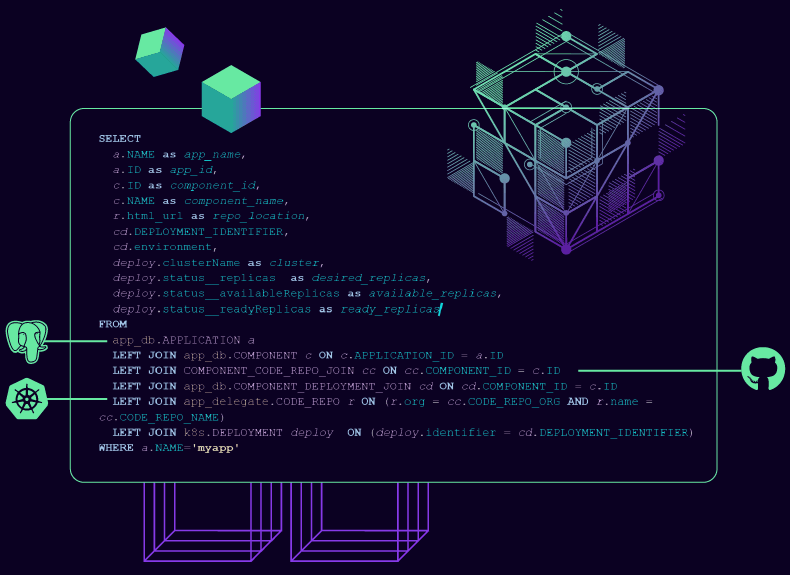
The screenshot below is a real federated query pattern: an API, application inventory and Kubernetes data resolved by one engine plan.
A global view is an option for cross-team questions, not a prerequisite for every cluster query.
Give a cluster, API group or platform system its own deployable Kubling boundary.
Aggregate the instances needed for a team, region or internal platform.
Federate domains for cross-team questions without forcing every query through one global instance.
System, domain and cross-domain describe roles in a topology, not products you must deploy as a fixed stack. A Kubling instance can use local providers, federate other Kubling instances, or do both.
Kubernetes and OpenAPI are current external providers. Both expose their exact model and capabilities through the same public provider contract.
Discovers listable resources dynamically and keeps the cluster identity stable in the federated model.
Inspect the providerDiscovers safe reads from OpenAPI 3.x and enables writes only through explicit mappings.
Inspect the providerThe in-memory sample exercises health, schema import, queries and mutations through the production provider contract.
Run it locallyQuery and mutate through a local provider, then replace the source when you are ready. The engine still plans against the same schema and capability contract.